

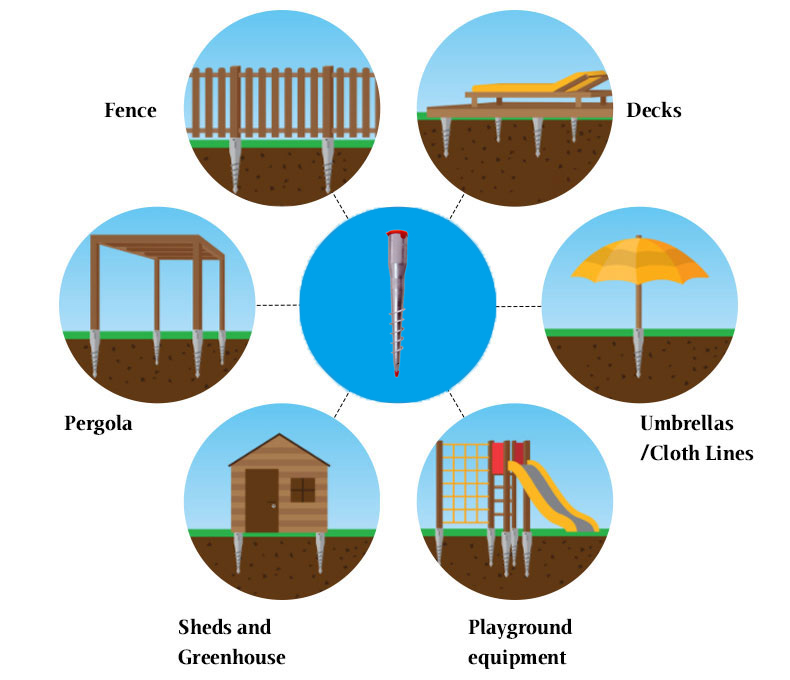
Ground Screw is becoming the preferred solution for installing light structures such as fences, pavilions, sheds and greenhouses, playground equipment, decks and parasols due to its high efficiency, flexibility and environmental protection. They are quickly anchored by mechanical screwing, without the need for excavation, pouring or maintenance. Its daily installation volume far exceeds that of traditional methods, and it is suitable for a variety of geological conditions. The following is an analysis from three aspects: application characteristics, regions, technical characteristics and comparison with traditional foundations.
1. Application areas: diversified coverage from home courtyards to public spaces
Fence industry anchor screws
Spiral anchors provide stable support for wooden, metal or plastic fences, especially for temporary or permanent fence installation in courtyards, gardens and public areas. For example, in a renovation project, a community quickly fixed a 200-meter-long garden fence with spiral anchors, which was installed in a single day without destroying the ground vegetation. Its detachable nature also facilitates the relocation or adjustment of the fence to meet temporary activities or seasonal needs.
Gazebo and Beach Umbrella Anchor Screws
Spiral anchors provide a stable foundation for outdoor structures such as gazebos and beach umbrellas, avoiding damage to the ground caused by traditional concrete pouring. In a resort expansion project, spiral anchors were used to fix 15 wooden pavilions, shortening the construction period by 60% compared with traditional methods, and the pull-out resistance design of the anchors meets the safety requirements in strong wind environments in coastal areas.
Sheds and greenhouse structures
In the construction of agricultural greenhouses, tool sheds or storage sheds, spiral anchors can quickly anchor the frame structure and adapt to different soil types. For example, a family farm fixed three small greenhouses with spiral anchors. Its modular design allows the greenhouse layout to be flexibly adjusted according to the needs of crop growth, and the corrosion resistance of the anchors extends the service life of the structure.
Playground equipment and children's activity areas
Spiral anchors provide safe support for amusement equipment such as swings, slides, and climbing frames, especially suitable for family courtyards or community children's playgrounds. In a renovation project, a kindergarten used spiral anchors to fix 10 sets of amusement equipment. Its dynamic load resistance meets the needs of children's high-frequency use, and the construction process is noise-free and dust-free, reducing interference with teaching activities.
2. Technical features: deep integration of efficiency, flexibility and sustainability
Construction efficiency and flexibility
The installation of spiral anchors only requires two steps: mechanical screwing and structural connection. A single anchor takes 10-30 minutes, and there is no need to wait for concrete to solidify. In a courtyard renovation project, the installation of a 200-meter fence was completed in just 2 days, saving 80% of the construction time compared to traditional methods. Its detachable characteristics also facilitate the relocation or renovation of facilities to meet the needs of scene changes.
Geological adaptability and pull-out resistance
By adjusting the diameter, spacing and pile length of the spiral blades, the spiral anchor can adapt to a variety of geological conditions such as sand, clay, and frozen soil. For example, when constructing in frozen soil areas, increasing the blade diameter can increase the pull-out resistance; in soft soil layers, increasing the number of blades can disperse stress and ensure structural stability.
Environmental protection and sustainability
The construction of spiral anchors is dust-free, noise-free, and construction waste-free. The pile body is made of hot-dip galvanized steel, which is highly corrosion-resistant and has a service life of more than 20 years. Its reusable characteristics enable the anchors to be recycled and reused when the facilities are moved or renovated, with a recycling rate of over 90%, reducing resource waste.
Aesthetics and compatibility
The ground part of the spiral anchor has no exposed structure and can be seamlessly integrated with the surrounding landscape. Its top interface is standardized (such as flanges and threads), compatible with a variety of connection methods, and adapted to the installation requirements of different structures. For example, in deck installation, the top of the anchor can be connected to a wooden or metal bracket to achieve concealed fixation.
3. Comparison with traditional foundations: a comprehensive breakthrough in efficiency, cost and flexibility
Construction efficiency comparison
Traditional concrete foundations require four steps of excavation, formwork, pouring, and maintenance, with a total cycle of several weeks and greatly affected by weather. Spiral anchors only need to be screwed in mechanically, and the daily installation volume can reach 5-10 times that of traditional methods, which is especially suitable for projects with tight schedules.
Cost structure comparison
Although the initial material cost of spiral anchors is slightly higher than that of concrete foundations, their total cost (including labor, machinery, construction period and maintenance) is lower. For example, in a playground equipment installation project, the total cost of the spiral anchor solution was 40% lower than that of the traditional method, and no subsequent maintenance was required.
Environmental impact comparison
The dust, noise and construction waste generated by concrete construction have a significant impact on the environment, while the construction process of spiral anchors is almost pollution-free. In addition, the removal of concrete foundations requires large machinery, which is easy to damage underground pipelines, while the removal of spiral anchors only requires reverse rotation, causing zero damage to the environment.
Flexibility and portability comparison
Traditional foundations are difficult to move after being fixed. If the location of the facility needs to be adjusted, it is necessary to reconstruct and dispose of the waste concrete. The detachable nature of the spiral anchor enables it to be reused. For example, during the renovation of a courtyard, the anchor of the original fence was moved to a new location, saving 70% of the installation cost.